
Sunday, July 24, 2016


"I Could Shoot Somebody and I Won't Lose Voters."
Today's New York Times Sunday Review (July 24) consists of 19 articles. Seven of these (37%) deal with Donald Trump. With publicity like this, who needs advertising?
 The Times, and so many of the media, continue to point out the many inconsistencies and lies he has perpetrated since the start of his successful campaign to win the Republican nomination. They continue to remind us of all his insinuations and insults on his way to that nomination - "lyin Ted, low-energy Jeb, little Mario, crooked Hillary," to mention a few. And his lies - thousands of New Jersey Muslims cheering 9/11, thousands of immigrant Mexican are rapists and murderers. And his innuendo and outlandish statements - Ted Cruz's father was complicit in the Kennedy assassination, Putin got it right, John McCain's no hero because he was captured ("I like people who weren't captured"). And many more.
We all are all too familiar with these atrocious and inciting Trumpian remarks.
What has all this done for Mr. Trump? Has it hurt him? Has it stopped him? In fact it has elevated him to an exalted position. He has captured a major political party, and has captured the loyalty of millions of disgruntled Americans who seem to regard him as almost "messianic." Incredibly, he has gone on to become the Republican nominee for President of the United States!
Trumpism demonstrates the desperation of so many American people today. Desperation exists - whatever the reason. It exists whether ill-founded (which it is) or not. And when such feelings enter one's brain and one's "soul" he/she anxiously searches for a "Trump." Lies, distorted history, or inaccuracies revealed about a demagogue are ignored, or otherwise rationalized as either not true, unimportant, or marked as an attempt to smear. Irrationality takes hold.
It is not unlike the philosophy behind theodicy - the acceptance of a god despite clear evidence of horrendous evils.
So media, give it up. As Trump said: "I could shoot somebody and I wouldn't lose voters."
And the New York Times, as well as many other media outlets, continue to provide this "wonderful father, husband, philanthropic businessman (just listen to his family's platitudes) and human being" the attention he doesn't deserve.
Tuesday, July 19, 2016
Obamacare and Medicare

A recent article in the New York Times (July 19) highlighted some major issues regarding the Affordable Care Act (Obamacare). The article was provoked by an essay in the Journal of the American Medical Association which emphasized some of the act's weaknesses.
Affordability remains a major problem, according to this discussion. It was thought that competition would help keep premiums affordable, but this has not been the case. The government is now considering adding a "Medicare-like public plan" to the mix. Private companies, however, already unable to sustain Obamacare requirements, would be even more likely to leave the plan with the adoption of a Medicare option which would significantly reduce the private marketshare by virtue of the invocation of a government controlled price option. Medicare would decrease physician reimbursement as well as hospital reimbursement.
A problem rarely discussed remains the one of physician availability in Medicare plans. More and more physicians, dismayed by lower reimbursement rates, are opting out of Medicare. This seems to be particularly true in urban centers. The Wall Street Journal reported that 9539 physicians opted out of Medicare in 2012 compared with 3700 in 2009. A recent study (2015) from the Kaiser Family Foundation surveying non-pediatric primary care physicians found that only 72% of the physicians are taking new Medicare patients, whereas 80% are accepting new patients with private insurance.
Medicare, the "safety-net" for senior citizens, is slowly losing physician-subscribers. This, too, requires addressing. Lowering reimbursement rates even further to bolster Obamacare will only tend to hasten this physician-departure.
Tuesday, May 24, 2016
Abortion not OK in Oklahoma

The Oklahoma legislature has approved a bill that makes the performance or induction of an abortion a felony, and any person found guilty of participating in this procedure can be punished with between one and three years in the state penitentiary*. This pertains to abortions at any point in fetal development, starting with the moment of conception. Oklahoma has ruled that life begins at conception. The deliberate taking of this human life could, then, be considered a form of murder.
This raises questions about penalizing the mother. Nothing was reported about how she should be punished, or if she should be punished. One cannot deny the fact that a women seeking an abortion in Oklahoma would be be aiding and abetting a felony. Is that not equivalent to a woman hiring a "hit-man" to murder her child?
And, of course, since the "morning after pill" could, if fact, be considered an abortifacient, I guess any woman resorting to such a pill to end a pregnancy could be sent to the state penitentiary for up to three years.
Such craziness!
*Physicians are apparently exempt from imprisonment, their punishment being limited to loss of license.
Addendum: Oklahoma's governor, Mary Fallin, has subsequently vetoed this bill.
According to the measure, known as SB1552, a person who performs or induces an abortion will be guilty of a felony and punished with between one and three years in the state penitentiary.
Saturday, April 16, 2016
To Pee or Not to Pee - Musings on Bathroom Use
 How does a woman know the sex of a person who is with her in the Ladies Room? Chances are overwhelming that a person who appears to be a woman is, in fact, a woman. Might it be a man? Why not? Even before the recent spate of transgender issues, it could have been a man with all the outward appearances of a woman.
On the other hand, would a woman using a Ladies Room feel uneasy if a person who has all the outward appearances of a man were to enter. This could very well be a man - but also a woman dressed as and acting as a man. Would this be more upsetting to a woman in the Ladies Room, than a person seemingly a woman who could, in fact, be a man?
The only way we men know the sex of the person standing next to us at the row of urinals in the Mens Room is the fact that he is, in fact, standing there next to us, not sitting there next to us. However, were everyone to "be seated" in separate stalls - whose to know who's who (or what)?
If genitalia remain unknown, if the chromosomes remain unknown, then you can never be absolutely certain of anyone's sex. Weren't there situations where we have all had questions as to the sex of someone encountered in the passing scene?
Perhaps the answer is a "genitalia check" by a security person before entry into a sex-designated bathroom is permitted.
But isn't that even more intrusive?
Thursday, March 31, 2016
Is Abortion Murder?


If you are the sort of person who truly believes that a fetus has rights equal to that of a fully birthed human being, then denying the fetus the full rights that apply to the fully birthed human human being does not logically follow, Right? Whether the "fetus" acquires these rights at conception, or at some point later in pregnancy (viability) is immaterial - at some designated point of fetal life these "human" rights are acquired.
If you are the sort of person who agrees that a fetus of whatever age has a "right to life," then a deliberate abortion of a fetus is a form of murder. Punishing solely the actual performer of the abortion but not the mother, and others who "aid and abet" this "procedure" seems illogical as well. Whether the "murder" of a fetus is somehow less than the murder of a "birthed" human is arguable, I guess. Nevertheless it might, at the very least, be judged a "depraved indifference to human life."
It appears, however, that the vast majority of the American people do not agree with this. Mothers who abort their pregnancies should not be punished.
If it is agreed that there should be no punishment for a mother who deliberately aborts her unborn child, but punishment should be exerted on a mother who kills her birthed child, then clearly fetal right-to-life is not equal to that of fully birthed human beings.
Fetal right-to-life has not reached the level of a moral imperative. And that's the way it should be.
Thursday, March 3, 2016
Trump, Trump, Trump


Donald Trump, Donald Trump. Everywhere you look, everything you read - all about Trump, Trump, Trump. Revile him all you want - he is a success as a presidential candidate. Deride him as often as you wish - it will neither harm him nor faze him. He is a media-master, far surpassing other candidates and even outdistancing the media stars and media pundits.
Donald Trump is a "problem," but not the basic problem - he is the result of the basic problem. He represents the disgruntled, disgusted middle-class American - Republican, Democrat and independent. He has hit a sensitive American nerve - he has come out. He has come out of the closet of political correctness and taken on the yelling and screaming popularized by Howard Beale, the disgruntled news anchor portrayed by Peter Finch in the 1976 award winning movie "Network." "I'm mad as hell, and I'm not going to take this anymore," he cried. "Bullshit," said Beale. "Bull****" says Trump!
Trump is a disaster - a demagogue, a clown, a liar, an evader, a fabricator of facts, an exaggerator ....... and more. He is without experience, without class, without decency, without respect for others ....... and more. But despite all this - he is forgiven! He remains the overwhelming choice of millions of Americans! He is the "People's Choice!" Trump is not responsible for Trump. We, the people, are responsible for Trump!
To quote Pogo, from Walt Kelly's comic strip of the same name, "We have met the enemy and he is us." Shame on Trump ....... Shame on Us!
Let's hope we will get better than we deserve!
Monday, February 1, 2016
God and the Holocaust

The recent obituary of a prominent Jewish theologian and scholar included the challenge of reconciling the horrors of the Holocaust with belief in God. It described how the "utter evil of the Holocaust" compelled not only Jews, but others, to re-consider and re-assess the meaning and contribution of the Enlightenment (the 18th century philosophical movement dominating European thought) which included the concepts of liberty, reason and tolerance.
It interests me that in attempting this reconciliation, the criticism is directed at the Enlightenment philosophy in general - critiquing the philosophy, but with a continued belief in God. Attempts to reconcile earthly horrors with the existence of a God continue. In other words, all explanations of great tragedies must be explained in the presence of the "incontrovertible fact" of the existence of a God. The possibility that such tragedies contravene this "fact" is never a consideration.
Are there not times to reconsider certain "supposed facts" (i.e. a God) when they seem to not correspond with observed facts? The monstrosity that was the Holocaust is such an observed fact (and of course there have been many others). It is certainly easier to explain such human horrors in the absence of an all powerful and loving deity than it is to accept such a deity's existence. These human catastrophes beggar the acceptance of and belief in a deity.
"Once-accepted facts" (e.g. a flat world, an earth-centered universe) disappear with the discovery of "new facts." Can a God-fact continue in the face of the real fact of The Holocaust and the continuation and constancy of human terror and slaughter. The answer seems to be - "Absolutely!!" But a great deal of upside-down reasoning and rationalization is required, don't you think?.
Thursday, January 7, 2016
Supporting Africa

I have been to Kenya and Uganda assisting Generis International, an organization dedicated to improving the education of children and women in East Africa. I learned very quickly that without "boots on the ground" you will never be assured that your donations are dispensed properly. The poverty seems vast and unending. Generis does put "boots on the ground." Though a very small organization, it is large in what it accomplishes. Small ideas can bring about large realities! Generis realizes it will not change the world, but can make it a better place for a few. Small institutions develop a personal relationship with the people - and via these small connections they are able to insure that their donations of money and material goods are properly used and dispensed by trustworthy local citizens. Generis purchases locally in Africa to support the local economy - e.g. school uniforms, or goats, or some sewing machines are purchased to train and educate African women and children - inspiring hope for the realization of a better and more comfortable life. Even pencils are known to make a difference!
Attempts by large organizations or NGO's to help are often impeded by hurdles of major proportions. In a recent NewYorker piece (Jan 4), Larissa MacFarquhar, writing about the Ford Foundation and its current president, Darren Walker, put it this way:
"The urge to change the world is normally thwarted by a near-insurmountable barricade of obstacles: failure of imagination, failure of courage, bad government, bad planning, incompetence, corruption, fecklessness, the laws of nations, the laws of physics, the weight of history, inertia of all sorts, psychological unsuitability on the part of the would-be changer, the resistance of people who would lose from the change, the resistance of people who would benefit from it, lack of practical knowledge, lack of political skill, and lack of money."
So true.
Generis knows this. But Generis has found the way - small in its operation, but so large in its calculated limited successes.
Saturday, December 12, 2015
Children and Contact Sports

Dr. Bennet Omalu, in an opinion piece in a recent issue of the New York Times, arrived at this conclusion concerning the possible damages that may result when children are involved in major contact sports, like football, at young ages. The conclusion drawn here, however, is purely suppositional. Children are not subjected to these "radiological and neurocognitive studies" as described and there is no factual knowledge about brain injury in these children. No such study has been done, to the best of my knowledge. That doesn't mean that such injury may not have occurred, but there is no data supporting the claim. As a rule, young children, with proper protective gear, rarely get injured from mild contact in sport as they are not heavy enough or strong enough to inflict such injury. Yes, it may come from falling on the ground, but rarely from contact with a rather light, small player.
Nevertheless, there would be nothing wrong with modifying contact sports so that injuries are less likely. Does football really require tackling at such a young age? Should head shots be eliminated in soccer for young players, etc.? Not only helmets, but well-regulated restriction of actions that could result in injury, may be very helpful in eliminating, or at least reducing injuries in children engaged in contact sports. One need not necessarily eliminate the sport, just modify some of the rules to make it safer.
Thursday, November 19, 2015
The Tired, Poor, and Huddled Masses

The outcry to ban Syrian migrants from the United States based on the possibility that one of the terrorists involved in the French attacks may (an I emphasize "may") have had a valid Syrian passport reminds me of the cries during World War II that helped restrict, if not eliminate, the acceptance of Jews attempting to escape the massacres perpetrated by Nazi Germany. Not only was immigration severely restricted, in part because similar fears of enemy infiltration, but Italian, German, and Japanese nationals, as well as those American citizens of the aforementioned ethnicities were interned or otherwise restricted.

German citizens were often detained as were American citizens of German descent. Many were removed from residences in coastal areas. A total of 11,507 Germans were interned during the war. 110,000 Japanese-Americans were interned.
Italian nationals in the United States during the war were also interned. Classified as "enemy aliens" they were detained under the Alien and Sedition Act. A total of 1881 were so detained, and a number of them were also relocated from coastal areas.
I am unaware of any seditious act that was proactively prevented by this relocation and internment policy.
We now have a decision to make. Will we ban all immigrants from the ravaged countries of the Middle East as a means of protection from ISIS terrorism? Hypothetically, If we knew that 5 terrorists were planning to enter this country disguised as Syrian refugees, should all refugees be banned? Even if a terrorist was able to kill some Americans, should we close our borders completely? As a matter of fact, isn't it possible that a terrorist could enter the United States as an ordinary tourist? And, furthermore, should we remove Arab muslims from coastal and densely populated areas?
Are we a society that is now ready to close its borders to the "tired, the poor" and the "huddled masses yearning to breathe free."
The world has become a dangerous place. ISIS must be contained and/or eliminated, and the means by which this can be brought about is unclear. But to close our doors and enclose ourselves in a tight protective shell that thousands of innocents will be prevented from penetrating, is clearly not a solution. It is surrender.
Monday, November 9, 2015
Questions a Doctor Should Answer

Doctors should answer a patient's questions. Doctors should invite questions and ask patients to come prepared with questions. If a doctor does not know the answer to a question, he should volunteer to get back with the answer. Doctors should never minimize the importance of a question, no matter how trivial it may seem. Doctors should understand that a patient may be upset, may not understand what is being related to him, and may need time to compute the information being provided.
Doctors should make certain that patients fully understand what has been told them. Studies have shown that a patient's comprehension and retention of the issues discussed is unreliable - frequently forgotten and/or misunderstood. Patients should write down (or perhaps record) what the physician is saying and review these notes with him before departing, insuring comprehensive certainty. Even better, bring along a relative or friend. Four ears and two brains are far better than two ears and one brain - especially if the information is serious and complex.
Questions for the physician might include:
1) What are the risks/benefits of the prescribed therapy?
2) How successful has this therapy been? Are there other forms of therapy to consider?
3) How common is my problem?
4) If an invasive procedure - what are the chances of complications or death?
5) How many procedures (if a procedure is to be done) have you performed?
6) How many patients with my problem have you treated?
7) What is the followup for my treatment or procedure - how often may it have to be repeated?
There may be others, specifically targeted to the medical issue at hand. There may also be time constraints and, perhaps, another visit for questions and discussion should be scheduled.
Commendably, many physicians will have proactively covered these questions in their discussions
having anticipated the patient's appropriate concern. But if not, one should not be afraid to ask.
Remember - as the doctor is interviewing you, you are simultaneously interviewing him.
Friday, October 23, 2015
Trump, Carson, and Joseph N. Welch


"You've done enough. Have you no sense of decency, sir? At long last, have you left no sense of decency?"
These famous words, the words of Joseph N. Welch, the Boston attorney representing the United States Army during the widely-viewed (and infamous) Army-McCarthy hearings in 1954, were directed at Senator Joseph McCarthy of Wisconsin. McCarthy had just accused a member of Welch's law firm of having been a member of the Communist Party during his youth.
It's time that at least one of the Republican presidential candidates level a similar condemnation of the spiteful, indecent, and ignorant words of Donald Trump and Ben Carson. Trump certainly has no understanding of "decency" - ridiculing his opponents for their appearance, or for their manner of speech, or because of a tendency to perspire. But the nadir came when he inferred presidential guilt for 9/11 - holding President George W. Bush responsible for the event. Outrageous!! Yes, he was our president at the time- in office for a total of eight entire months! And yes, President Roosevelt was in office in 1941 when Pearl Harbor was attacked - and perhaps President Lincoln should be held responsible for the Civil War which began one month into his presidency!
Carson's comparing the United States to Nazi Germany is similarly outrageous. Peter Wehner, in his New York Times op-ed piece on October 20 characterized Carson's remarks as showing a "staggering ignorance when it comes to the unique malevolence of Hitler's Germany."
"Staggering ignorance." An "imbecilic historical analogy," writes Wehner.
Carson went on to opine as to how Jews in Germany could have survived the Holocaust if only they were permitted to have guns!
"Staggering ignorance." An "imbecilic historical analogy."
Mr. Trump, Dr. Carson - you've done enough. Have you no sense of decency, gentlemen. At long last have you left no sense of decency?
Wednesday, September 30, 2015
What Pope Francis Didn't Say

Everyone loves Pope Francis - engaging, smiling, a man of the people - humble, loving - and a man of peace. Francis possesses a special charisma and "stage presence" unique to his office. Francis has filled his recent visit to The United States with pleas for peace, for ending poverty, for the caring of the young, the sick, and the old. He, in other words, echoes the hopes of humanity. Who can possibly be opposed to any of these pleas and hopes!
But words are not actions - and some words lack specifics. The very controversial Pope Pius XII, whose papacy spanned the era of Nazi Germany and World War II, also prayed and preached for peace and love. What he did not do, and why "controversial" is applied to his papacy, is that he failed to name names. He never directly condemned Hitler's policies, nor Mussolini's. He never denounced the Nazi perpetrators of the mass murders and human extermination that occurred during his papacy. His words may have made a difference, above all since many of the perpetrators were Catholic.
A general damning of war, human suffering and poverty- that's easy. What's difficult is directing such condemnation at those actually known to be at the root of human suffering. Like Pius, Francis has failed in this regard. As Pius failed with Hitler and Mussolini, so Francis is failing with Assad, with Khamenei, with Al Quaeda, with ISIS - and with all others responsible for the terrorism, murder, and genocide that plagues humanity today. Francis urges us to care for and to empathize with the teems of migrants desperate to find security and stability in Europe, but castigates no one responsible for this extraordinary display of despair. It is a noticeable silence.
The world knows the power of papal speech. Words matter. And the words of a pope, particularly such a beloved and charismatic pope, carry great moral weight. As we listen to his words, we must also listen to his silence.
Thursday, September 17, 2015
How To Pronounce "Los Angeles"
Ilan Stavans's recent op-ed article in the New York Times (Sep 17) discusses the American TV reporter Vanessa Ruiz's (an anchor for 12 News, Phoenix Arizona) insistence on pronouncing words and names that have a Spanish derivation in the Spanish manner. So, for example, her name RUIZ would be pronounced not as an anglicized ROO-iz, but in the Latino style Rrroo-ISS (with a rolled "r").
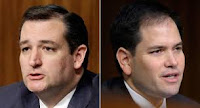 When Latino names and terms are pronounced by reporters or anchors with Latino backgrounds, they often assume that such names are preferably voiced in the Latino style. I hope they checked with the persons involved, because he/she may prefer the anglicized version rather than the Latino. I have never heard Senator Ted Cruz or Senator Marco Rubio pronounce their names using Hispanic rolled "r's". Their names are always anglicized when spoken to an American audience, which I feel rather confident in saying is the usage they prefer.
I once made the mistake of Italianizing a patient's surname, believing it would be the preferable form of address. I was dead wrong -- immediately corrected by the patient, who went on to pronounce his name using his preferred anglicized style.
My name, STEEG, is of German origin and in Germany is pronounced SHTEHG. I certainly do not prefer this to the anglicized form (rhymes with "league") and would resent an assumption that the German form is proper when used in the setting of an American conversation or discourse.
Stavans concludes his op-ed piece with the following: "Ms. Ruiz's use of Spanish pronunciations reflects the new social reality in which Shakespeare's tongue must adapt."
Really!!!
The names of people and places should be pronounced according to the wishes of those bearing those names or living in those places. The American city is Los AN-gel-ess, not Los AN-hel-ess, and the American state is Mon-TAN-ah, not Mon-Tahn-ya! Spanish derivation - yes. Spanish pronunciation - no.
Sunday, September 13, 2015
Malpractice - Myth or Reality

A recent NY Times Op-Ed piece entitled "Legislative Malpractice" prompted a number of contrary Letters-to-the Editor. These included critiques of juries of lay people who, the writer, averred, do not possess the proper credentials to adequately judge complex medical cases. Another noted that defending malpractice suits costs the health care system "hundreds of millions of dollars each year," and many are without merit. Myths or reality?
Some facts:
1. Researchers at Harvard School of Public Health have found that 97% of malpractice suits were meritorious. There is little "frivolous litigation" in malpractice suits.
2. The Institute of Medicine has estimated that 98,000 patients die each year as a result of preventable medical errors and hundreds of thousands more suffer nonfatal injuries. Other estimates are as high as 210,000-400,000 such deaths each year (Journal of Patient Safety 2013). Despite these numbers, malpractice suits comprise only 3% of all tort caseload. Only 30% result in a lawsuit. There are, then, far more instances of documented malpractice than there are malpractice lawsuits.
3. No more than 0.5% of malpractice payments resulted in an award of $1 million or more.
4. Despite the non-possession of "proper credentials" by jurors, a 2006 study discovered that juries found for the plaintiffs only 21% of the time. (By the way, "improperly credentialed" juries are also asked to decide complex financial issues, contracts, and other forms of very involved civil litigation.)
5. Medical negligence compensation accounts for only 0.3% of national healthcare costs.
6. So called defensive-medicine expenditures (ordering "unnecessary tests" to counter potential malpractice suits) do not result in a significant cost increase compared to total health expenditures.
7. Malpractice premiums, which are primarily driven by the general economic insurance cycle rather than by large malpractice awards, cost a typical physician just 3.2% of total revenue - far less than his/her rent.
8. Since 1987 medical costs have increased by 113%, while malpractice insurance has increased by just 52%.
9. Some states have adopted "collateral-source offsets" - costs covered by health insurance not recoverable by malpractice plaintiffs. With increased insurance coverage, greater "offsets" are expected, resulting in lower total indemnity payouts.
Last fact:
Many so-called malpractice issues are clearly more myth than reality. Competent physicians, who know what they are doing and how to do it, need have no malpractice qualms!
Thursday, September 3, 2015
The Kentucky Clerk and Dred Scott

Kim Davis, the Rowan County (Kentucky) clerk of courts is denying marriage licenses to same-sex couples, doing so, as she has stated, on "God's authority." Ms. Davis, whose deeply religious convictions oppose such marriages, is clearly in violation of the Supreme Court's landmark ruling in Obergefell v. Hodges whereby the constitutional right to same-sex marriage was affirmed based on the Fourteenth Amendment.
Ms. Davis's legal advisors have argued that, in fact, the decisions not to uphold Supreme Court rulings without supporting legislation has precedence in the famous Dred Scott case.
And, as a matter of fact, Davis's legal team has a point.
To review, Dred Scott, was a slave in the service of John Emerson, a member of the US military, who moved from Missouri (a slave state) to Illinois and Wisconsin (free states) in 1834. Though Emerson eventually returned to Missouri, Scott maintained that his residence in a free state had freed him from slavery bonds. The case finally worked its way up to the Supreme Court. In 1857, Chief Justice Roger Taney, writing for a 7-2 majority, ruled that Scott had no standing to sue in a federal court since people of African descent (slaves) were constitutionally not citizens of the United States. He concluded that the Declaration of Independence was never intended to pertain to slaves. Slaves, he continued, being, in fact, property, remained so in whatever state their owners may reside.
The Dred Scott decision helped launch the Civil War, and became what is considered the worst Court decision in U.S. history.
Northern courts and politicians rejected "Scott"as binding. The Ohio Supreme Court ruled that any slave coming into the state with his master’s consent, even as a sojourner, became free and could not be reenslaved upon returning to a slave state; the New York Court of Appeals handed down a similar ruling in Lemmon v. The People (1860). In several states, legislatures resolved to prohibit slavery in any form from crossing onto their soil and enacted legislation freeing slaves passing within their borders. Abraham Lincoln, himself, did not follow this ruling. With his Emancipation Proclamation he claimed the executive right to free slaves in the rebellious states.
So, in fact, the "law of the land," was not followed in Northern jurisdictions. The case remained "the law of the land" until "overturned" by the passage of the Fourteenth Amendment following the Civil War.
Wednesday, August 26, 2015
"Anchor Babies and Tourist Babies"

The latest controversial issue raised by Donald Trump is the "anchor baby" - which I believe he defines as a baby born to a mother who entered the United States for the sole purpose of insuring that her infant is born in the United States, thereby guaranteeing her child United States citizenship, by virtue of the 14th Amendment. Trump is questioning the interpretation of the 14th Amendment.
The pertinent part of the amendment read as follows:
Section. 1. All persons born or naturalized in the United States and subject to the jurisdiction thereof, are citizens of the United States and of the State wherein they reside.
This has been interpreted by some to exclude children of non-citizens or non-resident aliens since these children are not "subject to the jurisdiction" of the United States as they are children of citizens of other countries. In fact current immigration law specifies that a baby born on American soil to a member of the foreign service of another country or a foreign military prisoner is not an American citizen by birth. Congress can, however, grant citizenship for such excluded persons on a case-by-case basis.
Let's assume that, in fact, the 14th Amendment actually does permit any infant born on U.S. soil to be eligible for automatic U.S. citizenship. In fact many of these babies, also referred to as "tourist babies," are not born to "illegal aliens," but to foreign women with tourist visas - often owners of U.S. real estate - who are among the privileged class in their countries, and wish to insure U.S. citizenship for their offspring.
Isn't there something wrong with this concept? Isn't there something "not right" when pregnant citizens of other countries enter the U.S. for the sole purpose of giving birth to "an American baby?"
By the way, know that the United States is one of the few countries that has such "jus soli" (by right of the soil) citizenship rights. The vast majority of other countries do not. Some of examples of "non-birthright" states include Australia, United Kingdom, Germany, Israel, Saudi Arabia, Czech Republic, Japan, Austria, Belgium, Switzerland, Norway, Sweden, Finland, Denmark, France, Greece, Spain, Italy.......and quite a few more.
.
Wednesday, August 12, 2015
Pounds and Ounces in Prevention and Cures

We're all well aware of the old adage that "an ounce of prevention is worth a pound of cure." Well, as it turns out - not so! Margot Sanger-Katz, in a recent New York Times article (Aug 7), has written how the opposite is true. Turns out, in fact, that "you have to give a lot of people those ounces of prevention to end up with one person who's getting that pound of cure." As an example, according to the New England Journal of Medicine, 2500 women would have to be screened over 10 years for a single breast cancer death to be avoided.
Prevention is not cheap. Obamacare mandates prevention coverage. More and more subscribers are confirming the status of their general health by taking advantage of these screening options, consequently increasing health care costs. Providing people with more preventive measures is satisfying and usually reassuring, but expensive and rarely productive.
Early discovery of diseases using preventive screening techniques may result in a longer life - but at a not insignificant expense. Early intervention for an asymptomatic latent condition results in increased physician visits, increased diagnostic testing, increased need for the preventive medication, and, of course, an increase in cost. The disease is almost never cured, but its process is prolonged, and death may be delayed. However, as one survives this condition to live on to an advanced age, the occurrence of other diseases such as Alzheimer's, or other costly illnesses, increases greatly.
Staying healthy is not cheap. A lot of health care dollars are spent on prevention and a prolonged life. Preventing diseases is good, new treatments are good. But none of this occurs without significant cost.
It takes dollars of prevention for one cent of cure!
Thursday, August 6, 2015
Discussing Livers and Hearts Over Lunch
So much of what one says in a private tête-à-tête is dissimilar from what one would otherwise say.

The recent videos of officials from Planned Parenthood discussing the distribution of fetal parts, between bites of salad during a private lunch, is not a reason to critique the issue or to defund a program. One may understandably be opposed to late-term abortions or the use of fetal tissue in research efforts to advance medical science, but such a conclusion should not be based on private "intra-professional" conversations.
Physicians often discuss patient-related issues or disease-related issues over coffee or lunch. Yes, we take bites of hamburgers while discussing illnesses, and may even chuckle or laugh during the conversation as we talk about an unusual situation that may have come up - not always using "appropriate language." Operating rooms and diagnostic labs are filled with, what some might term, rather irreverent banter. It is the nature of our "business." It is in the nature of any "business" to speak "informally" when "businesss" matters are tossed around among close colleagues.
Saucy collegial conversations regarding medical issues are very common. One should not use such surreptitiously recorded conversations as a tool to promote or condemn a point of view.
Subscribe to:
Posts (Atom)